
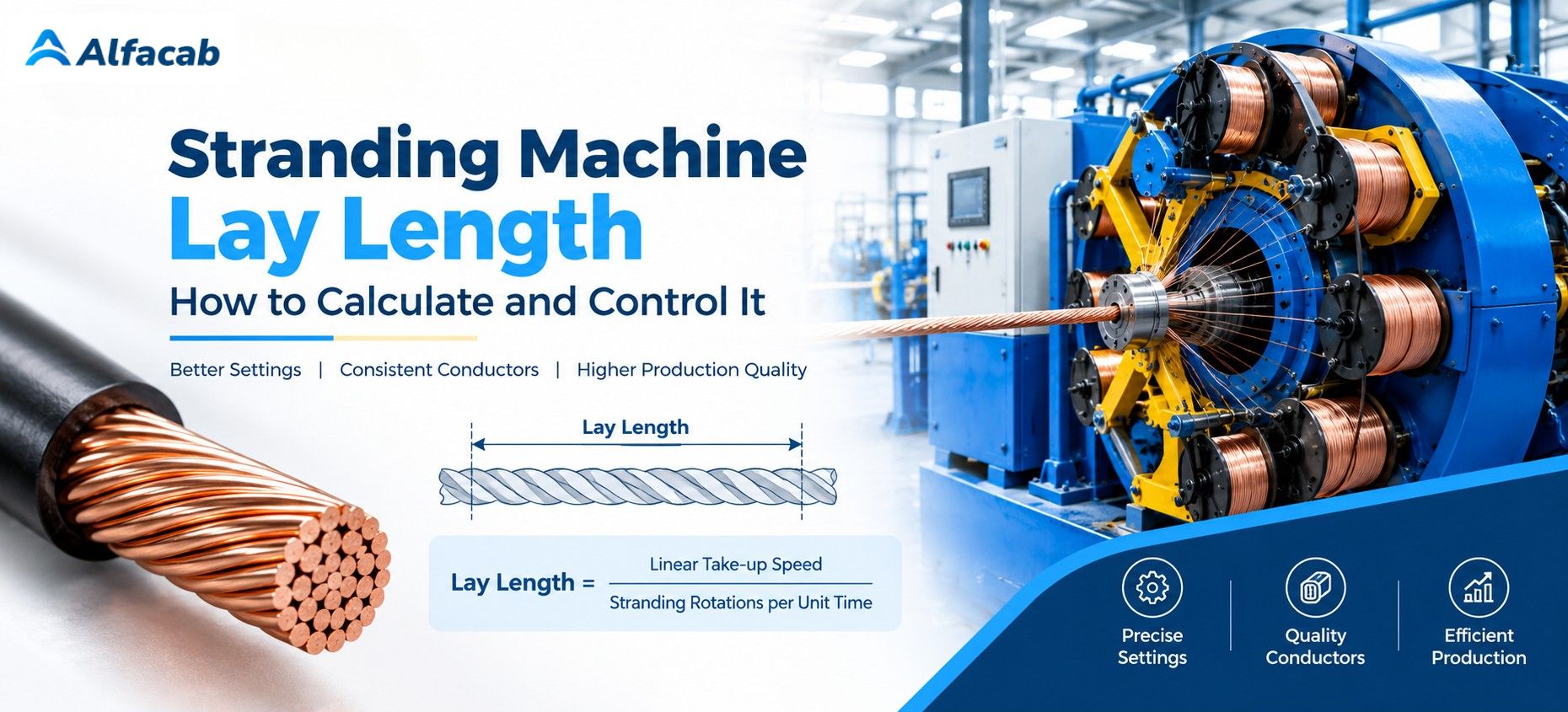
In wire and cable manufacturing, maintaining the correct lay length is essential for producing consistent stranded conductors. An incorrect setting can affect strand geometry, conductor flexibility, and finished cable quality. For manufacturers, understanding how lay length works and how to control it helps improve process consistency and reduce avoidable production errors.
Alfa Cab Industries focuses on conductors and cable machinery manufacturing. Understanding lay length is useful when evaluating a cable stranding machine, or rigid stranding machine for specific production requirements.
What Is Lay Length in a Stranding Machine?
Lay length is the axial distance over which a strand or wire completes one full helical turn around the central axis of a stranded conductor or cable. It is commonly expressed in millimetres or metres.
In cable manufacturing, lay length influences the geometry of the finished conductor. A shorter lay generally produces a tighter twist, while a longer lay produces a more open twist, depending on the conductor construction.
The term lay length of wire rope describes a related concept, but wire rope construction and electrical cable stranding have different requirements. Manufacturers should use the applicable product specifications when determining the correct lay length.
How Lay Length Works in a Rigid Stranding Machine
A rigid stranding machine combines individual wires into a stranded conductor through a coordinated stranding and take-up process. Its configuration determines how wires are arranged and twisted around the conductor axis.
Lay length depends on the relationship between the effective stranding rotation and the speed at which the conductor advances through the machine. The required setting also depends on the machine design, conductor construction, and production specifications.
A rigid stranding machine may be suitable for manufacturing stranded conductors used in different wire and cable applications. However, manufacturers should verify the machine's available configurations, conductor capacity, and operating parameters before selecting equipment.
How to Calculate Lay Length in Cable Manufacturing
Lay length can be calculated using the effective stranding rotation and the linear advancement of the conductor.
Basic formula:
Lay Length = Linear Take-up Speed ÷ Effective Stranding Rotations per Unit Time
For example, suppose a machine advances the conductor at 30 metres per minute and produces 60 effective stranding rotations per minute.
Lay Length = 30 ÷ 60 = 0.5 metres
Therefore, the calculated lay length is 500 mm per effective rotation.
This example assumes that one effective rotation corresponds to one completed lay. Actual stranding machines may use different mechanical arrangements, gear ratios, or twisting mechanisms. Double-twist and planetary systems, for example, may have different relationships between machine rotation and lay formation.
For accurate results, manufacturers should refer to the machine's operating manual and verify the calculated value through physical measurement.
How to Adjust Lay Length on a Stranding Machine
Correct adjustment begins with identifying the required lay length from the conductor specification. Operators should then confirm the machine's configuration and determine which settings control the relationship between stranding rotation and take-up speed.
The following practices can help maintain consistency:
- Set the required lay length according to the conductor specification.
- Verify the applicable machine settings before starting production.
- Check rotational speed and take-up speed where relevant.
- Measure the actual lay length on the produced conductor.
- Compare measurements against the required manufacturing tolerance.
- Record production settings and inspect for variations during operation.
Any adjustment should follow the manufacturer's operating instructions. Operators should not assume that changing rotational speed alone will produce the desired lay length without considering the take-up system and machine configuration.
Factors Affecting Lay Length in Stranding Machinery
Several factors can influence the final lay length of a stranded conductor.
Machine configuration: The stranding mechanism determines how rotation translates into strand formation.
Rotational and take-up speeds: Their relationship directly affects lay length in systems where these parameters govern the process.
Conductor construction: Wire diameter, strand count, and the arrangement of wires influence the required lay specification.
Mechanical condition: Wear, slippage, or issues with relevant drive components may contribute to variations.
Operating settings: Incorrect setup parameters can cause the produced conductor to differ from the intended specification.
Understanding these factors helps manufacturers identify possible causes of inconsistent lay length and establish suitable inspection procedures.
Common Lay Length Problems and Their Solutions
Inconsistent lay length can result from incorrect machine settings, changes in operating conditions, mechanical issues, or an incorrect understanding of the machine's stranding mechanism.
If the measured lay length differs from the target, first verify the measurement method and required specification. Next, check the relevant speed settings, machine configuration, and mechanical components according to the operating manual.
Uneven twisting or visible strand deformation should also be investigated. These symptoms may have multiple causes, so manufacturers should avoid changing settings without identifying the underlying issue.
Regular inspection, accurate measurements, and documented production settings can help improve repeatability and reduce unnecessary adjustments.
Understanding Stranding Machine Types
Different stranding machine types serve different manufacturing requirements.
A rigid stranding machine is used to assemble multiple wires into stranded conductors. Its suitability depends on the required conductor construction, machine capacity, and production specifications.
A drum twister machine is designed for particular cable twisting and stranding applications, depending on its configuration. Manufacturers should evaluate the cable construction and required process before choosing this type of equipment.
A Pourtier stranding machine is another term encountered in the stranding machinery industry. Buyers researching this equipment should compare the specific machine configuration, technical specifications, and intended application rather than relying on the machine name alone.
When comparing cable stranding machinery, consider the required lay length, conductor size, number of wires, production speed, take-up arrangement, and operating requirements.
Choosing the Right Stranding Machine from Alfa Cab Industries
Selecting a suitable machine starts with clearly defining production requirements. Cable manufacturers should identify the conductor material, required cross-section, number of strands, target lay length, and expected production output.
They should then compare these requirements against the available machine specifications. Important considerations include the stranding mechanism, speed range, compatible conductor configurations, take-up capacity, maintenance requirements, and operating instructions.
AlfaCab Industries can be considered when evaluating machinery for conductor and cable manufacturing requirements. Before making a purchase decision, manufacturers should confirm the available machine models, technical capabilities, and configuration options directly with the company.
The right equipment should match the intended application and support the required manufacturing specifications.
Conclusion
Lay length is an important parameter in stranded conductor manufacturing because it influences strand geometry and consistency. Understanding its calculation, measurement, and adjustment helps manufacturers identify production variations and select appropriate machinery.
Alfa Cab Industries is a relevant point of contact for manufacturers evaluating conductor and cable machinery. Contact Alfa Cab Industries to discuss your production requirements and identify suitable stranding machinery for your application.
