
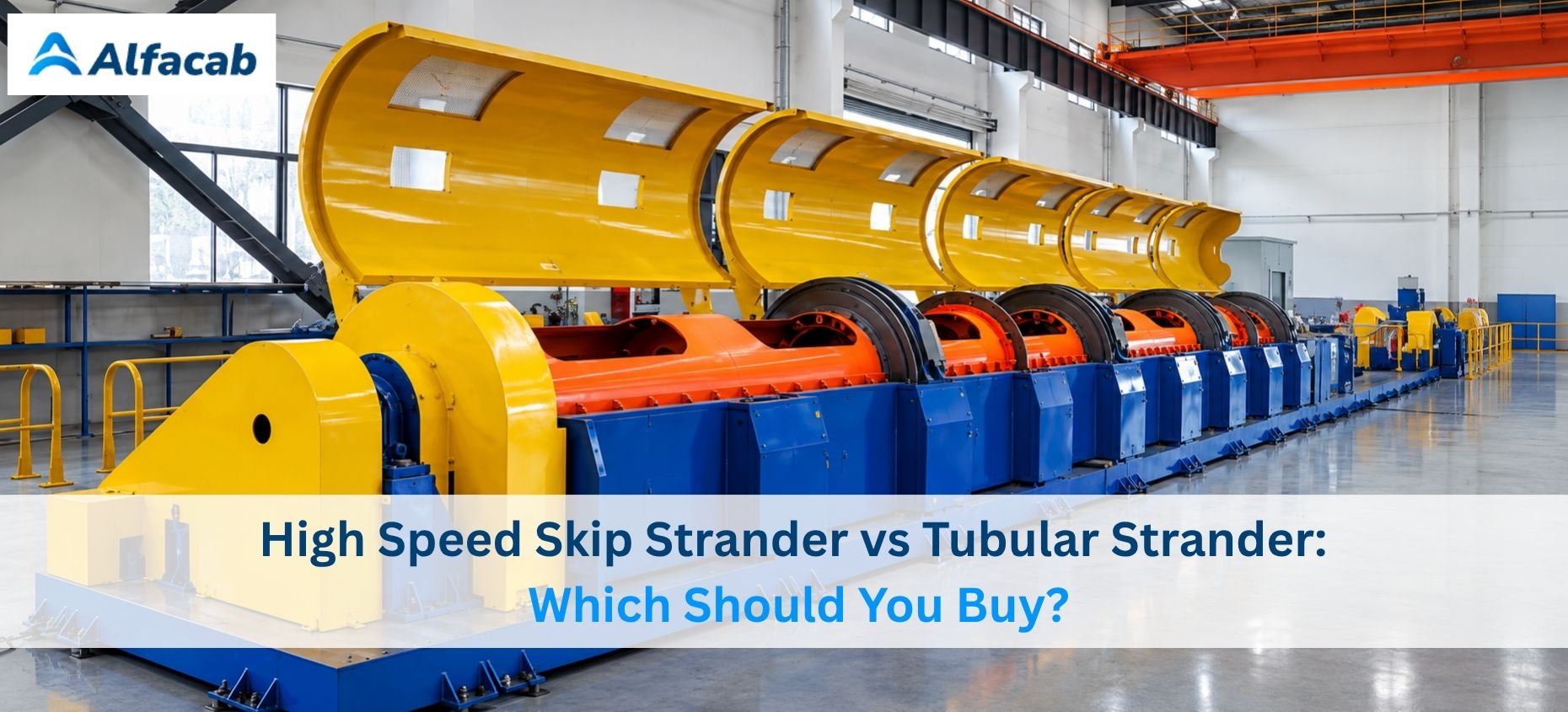
Choosing the right stranding machine is an important decision for wire and cable manufacturers. The machine you select can influence production output, conductor configuration, operating costs, and finished product quality. Two options worth comparing are the high speed skip strander and the tubular strander.
Although both machines are used in stranding operations, their mechanical designs, operating characteristics, and suitability for different production requirements can vary. Understanding these differences helps manufacturers choose equipment that aligns with their wire specifications, production targets, and budget.
In this guide, AlfaCab Industries explores the key differences between skip stranders and tubular stranders to help you make an informed purchasing decision.
What Is a High Speed Skip Strander?
A high speed skip strander is a wire stranding machine designed to combine multiple individual wires into a stranded conductor. Its skip-type stranding arrangement allows wires to be laid together while the machine maintains the required stranding geometry.
Depending on the machine configuration, skip stranders may be considered for applications requiring consistent conductor formation and efficient production. Their suitability depends on factors such as wire diameter, the number of wires, required lay length, operating speed, and the finished conductor specification.
Before purchasing a high speed skip strander, manufacturers should check its rated production speed, compatible wire sizes, take-up capacity, safety systems, and achievable lay-length range.
What Is a Tubular Strander?
A tubular strander is a wire stranding machine that uses a rotating tubular structure to guide and strand individual wires around a central wire or core, depending on the configuration.
A tubular strander machine may be used in manufacturing operations that require specific conductor constructions and controlled wire positioning. The machine's suitability depends on the design, number of bobbins, wire dimensions, stranding arrangement, and production requirements.
When evaluating a wire tubular strander, buyers should review its bobbin capacity, permissible operating speed, tension-control arrangements, guarding, and compatibility with the intended conductor design.
High Speed Skip Strander vs Tubular Strander: Key Differences
The main difference between these machines is their mechanical arrangement and the production requirements they are designed to handle. Neither machine is automatically the better choice for every manufacturing application.
|
|
|
|
|
|
|
|
|
|
|
|
|
|
|
|
|
|
|
|
|
|
|
|
|
|
|
|
Which is faster: a skip strander or a tubular strander? There is no universal answer. Actual output depends on machine design, wire specifications, lay length, loading, setup time, and operating conditions. Compare technical specifications and achievable production output rather than relying on the machine name alone.
Skip Strander vs Tubular Strander: Applications
The right machine depends on the type of conductor being manufactured and the specifications required by the customer.
A high speed skip strander may be suitable for applications where its particular stranding arrangement meets the required conductor construction and production targets. A tubular strander may be appropriate where its rotating tubular design and bobbin arrangement suit the intended stranding process.
Before selecting either machine, identify:
- The conductor material and individual wire diameter.
- The required number and arrangement of wires.
- The target conductor diameter and lay length.
- The expected production volume and operating schedule.
- The finished conductor's flexibility and quality requirements.
These details help narrow down the appropriate machine configuration.
Production Speed and Manufacturing Efficiency
Production speed matters, but maximum revolutions per minute do not tell the whole story. Manufacturers should evaluate usable output under the actual operating conditions.
For example, a machine's rated speed may not translate directly into higher daily production if frequent bobbin changes, setup adjustments, wire breakage, or extended downtime affect operations.
When comparing a high speed tubular strander with a skip strander machine, review the rated operating speed, achievable lay length, changeover time, tension control, and expected maintenance requirements. Ask the manufacturer to clarify the conditions under which its stated production figures are achieved.
Wire Size, Conductor Configuration, and Capacity
Machine compatibility is one of the most important purchasing considerations. A wire stranding machine must support the required wire diameters, number of strands, conductor arrangement, and finished dimensions.
Do not assume that every tubular strander or skip strander can handle the same wire sizes. Request a technical specification sheet and confirm that the proposed configuration meets your production requirements.
Manufacturers should also check bobbin dimensions, loading arrangements, take-up capacity, and the achievable lay-length range before placing an order.
Skip Strander vs Tubular Strander: Price and Operating Costs
The price of a stranding machine depends on its configuration, production capacity, automation, included accessories, and manufacturer specifications. Installation, operator training, spare parts, electricity consumption, and routine maintenance can also affect the overall investment.
When comparing quotations, evaluate the total cost of ownership rather than the purchase price alone. Ask suppliers to list the included components, warranty terms, delivery schedule, installation support, and after-sales service.
A machine that matches your production requirements can offer better long-term value than equipment selected only because it has a lower initial price.
Maintenance and Operational Considerations
Regular maintenance supports consistent operation and helps reduce unplanned downtime. Depending on the machine design, maintenance may involve inspecting bearings, lubrication points, tensioning components, drive systems, bobbin holders, and safety guards.
Before purchasing, ask about the recommended maintenance schedule, availability of replacement parts, operator training, and troubleshooting support. Also confirm that the machine includes suitable guarding and safety provisions for its intended operating conditions.
Which Stranding Machine Should You Buy?
Choose a high speed skip strander if its specified configuration meets your conductor requirements, production targets, and operating preferences. Consider a tubular strander if its mechanical arrangement and bobbin capacity are better suited to your intended application.
The best decision comes from matching the machine's documented capabilities to your actual manufacturing needs.
AlfaCab Industries works in conductors and cable machinery manufacturing. If you are evaluating a wire stranding machine in India, prepare your wire specifications, required output, conductor configuration, and budget before requesting a quotation. This information helps establish whether a skip strander, tubular strander, or another machine configuration deserves consideration.
Conclusion
Selecting between a high speed skip strander and a tubular strander requires more than comparing machine names or advertised speeds. Wire dimensions, conductor construction, production targets, maintenance needs, and total ownership costs should guide your decision.
Contact AlfaCab Industries to discuss your conductor specifications and explore suitable cable stranding machinery for your manufacturing requirements.
